
Every FTTH build hits the same design question: place traditional conduit and pull cable, or place microduct and blow fiber in? The answer affects crew methods, material lists, and how easily you can add fiber years from now. This guide covers the practical differences, where each fits, and what BEAD-funded projects should keep in mind, for OSP contractors, engineers, and the ISPs, co-ops, and utilities that own the network.
What we mean by “traditional conduit” and “microduct”
Traditional conduit usually means HDPE (sometimes PVC) duct in nominal inch sizes, such as 1.25-inch or 2-inch, placed by trench, plow, or directional bore. Cable is typically pulled in with a winch and pull line.
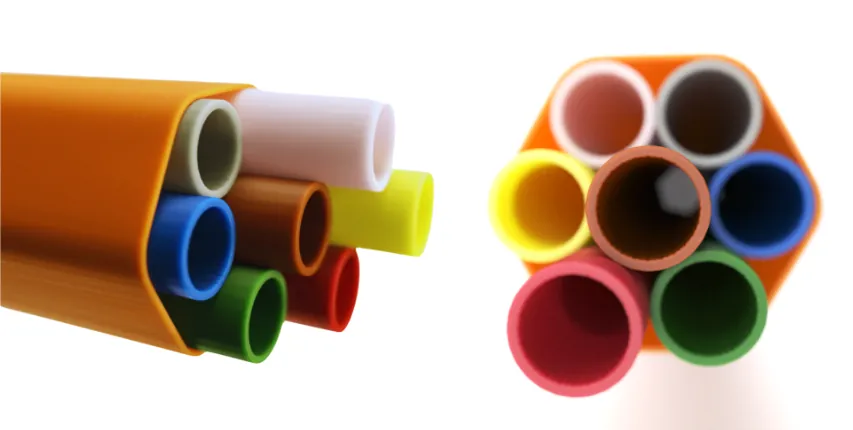
Microduct is small-diameter HDPE duct sized in millimeters, listed as outside/inside diameter (for example 10/8 mm). According to the Plastics Pipe Institute, microducts typically range from about 5 mm to 27 mm OD. They come as single ducts or sheathed bundles. Thin-wall microduct goes inside a larger carrier conduit, and thick-wall or sheathed bundles are made for direct burial. Fiber goes in by air-assisted blowing (jetting).
Microduct vs. conduit at a glance
| Factor | Traditional conduit | Microduct |
|---|---|---|
| Typical sizing | Nominal inches (e.g., 1.25″, 2″) | Millimeters, OD/ID (roughly 5–27 mm OD) |
| Pathways per placement | Usually one cable path per duct unless subdivided | Multiple independent paths in one bundle or carrier conduit |
| Fiber installation | Usually pulled; larger air-assist systems also used | Air-blown (jetted) microcable or fiber units |
| Adding capacity later | Pull another cable, subdivide, or dig again | Blow new fiber into spare microducts |
| Best fit | Larger or legacy cables, mainline/feeder, mixed-use pathways | FTTH distribution, drops, dense routes, future-ready capacity |
| Locating | Needs tracer wire or another locate method | Needs tracer wire or another locate method (some microduct comes with locate wire) |
| Crew skills and equipment | Familiar pulling methods | Blowing equipment, fittings, and microduct handling practices |
Where microduct makes the most sense
Future capacity without re-digging
Getting into the ground is usually the most expensive part of an underground build. Microduct lets you place several pathways in one trench or bore and leave spares empty. When a new subdivision or business needs fiber later, you blow cable into a spare duct instead of digging again.
Air-blown installation
The Plastics Pipe Institute notes that jetting lowers sidewall and tail loads on the cable, which cuts installation stress and can allow longer runs with fewer setups and access points than winching.
Dense routes and existing conduit
Microduct can be placed inside existing conduit, and in some cases alongside a cable that’s already there (“overriding”), adding capacity without new construction. Confirm the fill and condition of the existing duct before planning an override..
Where traditional conduit still earns its place
Traditional conduit remains a strong choice when:
- You’re placing larger cables, such as high-count feeder, that won’t fit microduct sizes.
- The route needs a general-purpose pathway, possibly for non-fiber cables.
- Your crews are set up for pulling, and the job doesn’t justify blowing equipment.
- You want a rugged carrier that can later hold thin-wall microduct.
It’s usually not either/or
Many practical designs combine the two: HDPE conduit as the protected carrier on mainline routes with microduct inside it, and direct-buried microduct bundles on distribution and drop segments. The right mix depends on route length, install method, cable counts, and expected growth.
Planning checklist for a microduct design
Work through these with your engineer, cable supplier, and duct manufacturer:
- Duct size vs. cable diameter. Blowing performance depends on fill ratio. The Plastics Pipe Institute’s PE handbook gives about 50–75% as the optimal cable fill for air-assisted installation. Always check your cable and duct manufacturers’ recommendations for your specific combination..
- Wall type. Thin wall inside carrier conduit; thick wall or sheathed bundles for direct burial.
- Inner surface. Smooth or ribbed walls affect blowing. Match the duct to your cable and equipment.
- Color coding. Plan colors and stripes so crews can identify each duct at every access point.
- Fittings. Couplers, reducers, end caps, and gas-block fittings must match the duct sizes.
- Locating. HDPE duct and dielectric fiber can’t be located on their own, so plan tracer wire and grounding from the start (see our Copperhead tracer wire systems page).
BEAD and BABA: what to keep in mind
The Broadband Equity, Access, and Deployment (BEAD) program is a $42.45 billion federal program created by the Infrastructure Investment and Jobs Act and run by NTIA through state broadband offices: in our territory, the Michigan High-Speed Internet Office (MIHI), the Indiana Broadband Office, and BroadbandOhio. NTIA restructured parts of BEAD in 2025, so work from your state’s current guidance. For Michigan background, see our post on understanding BEAD grants in Michigan.
BEAD projects are subject to the Build America, Buy America (BABA) Act, which generally requires iron, steel, manufactured products, and construction materials used in federally funded infrastructure to be produced in the United States. The Department of Commerce issued a limited BEAD waiver (effective February 2024) that waives BABA for most electronics and a few narrow inputs, while setting specific U.S. manufacturing requirements for optical fiber and fiber-optic cable. Conduit isn’t one of the categories that waiver broadly exempts. Under federal BABA guidance, plastic and polymer products like HDPE duct are generally treated as construction materials that must be manufactured in the U.S. Confirm the classification, and any de minimis or project-specific waiver, with your state broadband office..
Practical takeaways:
- Ask every duct supplier where your specific order will be manufactured and what BABA documentation they’ll provide, and keep it with your project records.
- Don’t assume a whole catalog is compliant. Confirm the exact products and plant for your job.
LYNDDAHL Telecom America can supply every microduct size from its plant in Belmont, North Carolina, giving you U.S. manufacturing positioned for BEAD / BABA-aligned projects. OSP Materials can help you confirm production location and documentation for your order before you commit to a spec.
LYNDDAHL microduct in Michigan, Indiana, and Ohio
OSP Materials is the manufacturers representative for LYNDDAHL Telecom America across Michigan, Indiana, and Ohio. LYNDDAHL builds complete, tailored microduct solutions: HDPE microduct from 5 mm to 27 mm in many colors and bundle configurations, thick or thin walls, smooth obed inner surfaces, sheathed outdoor and indoor options, and matching fittings including connectors, reducers, end caps, and gas-block fittings.
See the full lineup on our LYNDDAHL microduct page, download theLYNDDAHL microduct data sheet (PDF) for sizes, reel lengths and specs, or browse our whole line card on the Partners page.
Planning a fiber build in MI, IN, or OH? Call (616) 881-1720, email [email protected], or request a quote. We’ll help you size ducts, choose bundles and fittings, and line up LYNDDAHL microduct for your next FTTH or BEAD project.
FAQ
Is microduct cheaper than traditional conduit?
It depends on the route. Microduct can lower lifetime cost by letting you add fiber without new digging, but costs vary by project, so compare full installed cost, not just price per foot.
Can microduct go inside existing conduit?
Yes. Thin-wall microduct is commonly placed inside larger carrier conduit, and some projects add microduct to occupied conduit (“overriding”). Check the existing duct’s condition and fill first.
Do I still need tracer wire with microduct?
Yes. HDPE microduct and dielectric fiber can’t carry a locate signal on their own, so plan a tracer wire system (or microduct with integrated locate wire) plus proper grounding.
Is LYNDDAHL microduct BABA-compliant for BEAD?
LYNDDAHL can supply every microduct size from its plant in Belmont, North Carolina, which positions it for BEAD / BABA-aligned projects. Compliance depends on the specific products, production location, and documentation for your order. Contact OSP Materials and we’ll help you confirm it with LYNDDAHL before you finalize your spec.